Aida cloth is the most common woven fabric used for cross-stitch, and it is popular for one reason: it does the counting for you. The weave forms a visible grid of squares, and each square takes one stitch. That removes the hardest part of learning counted embroidery.
How the weave works
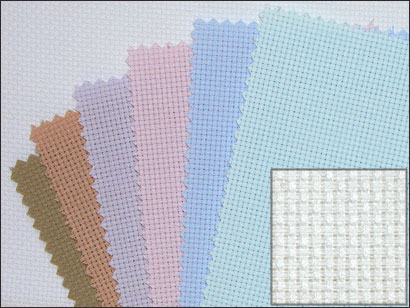
In Aida cloth the threads of the warp and the weft are woven closely in groups, with tiny spaces separating one group from the next. The result is a regular grid of small holes at even intervals across the whole fabric.
Those gaps are the point. They are spaced regularly and sized to accommodate threads of different thickness, so the needle passes through an obvious hole rather than being pushed between threads. Every square becomes one cross stitch, and the pattern on the chart maps directly onto the fabric.
What the count number means
Aida is sold by count, and the count is simply the number of squares per inch. A 6 count Aida cloth gives 6 cross stitches per inch. A 12 count gives 12 cross stitches per inch.
The rule that follows is the one to remember: the higher the number, the finer the weave. A high count packs more, smaller stitches into the same inch, producing finer detail and a smaller finished piece from the same chart.
The standard counts
Cotton Aida cloth is commonly available in the following thread counts: 6, 8, 11, 14, 16 and 18.
- 6 and 8 count. Very large squares. Easy to see and easy to stitch, which makes them the usual choice for children and for anyone learning.
- 11 count. Still generous, and comfortable to work without magnification.
- 14 count. The most widely used size and the count most published charts assume.
- 16 and 18 count. Fine work. More detail, a smaller finished piece, and considerably more demanding on the eyes.
Choosing a count
Two things follow from the count you pick, and both matter before you start.
The first is finished size. The same chart worked on 18 count comes out roughly half the size it would on 9 count, because the stitch count is fixed and only the stitches-per-inch changes. Work out the finished dimensions before buying the fabric, particularly if the piece has to fit a frame.
The second is thread thickness. Finer counts need fewer strands of floss to cover the fabric properly. Using too many strands on a high count crowds the stitches; using too few on a low count leaves fabric showing through.
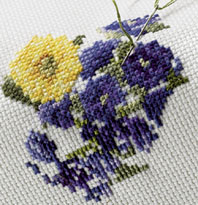
Colors
Aida cloth comes in many colors. The most common are white, beige and brown, and those three cover most published designs. Colored grounds are widely available and change a design considerably, since the unstitched fabric becomes part of the picture rather than a blank.
Frequently asked questions
Is Aida cloth always cotton?
The standard is 100 percent cotton. Blends exist, but cotton is what most patterns and most stitchers assume.
What count should a beginner use?
11 or 14. Below that the stitches look coarse; above it the holes become hard to see without good light or magnification.
Why does my finished piece look smaller than the pattern?
Because you used a higher count than the pattern assumed. The stitch count is fixed by the chart, so a finer fabric produces a smaller result.
How is Aida different from evenweave or linen?
Aida groups its threads into distinct blocks with obvious holes between them. Evenweave and linen have a uniform surface with no visible grid, so stitches are worked over a counted number of threads instead. Aida is much easier to start with.