Almost every complaint about bras is a fit complaint. Digging straps, a band that rides up, cups that wrinkle or overflow: each of these is a specific, diagnosable problem with a specific fix. Work through the four components in order and you can identify what is wrong in a couple of minutes.
The band
Start here. The band does most of the supporting work, and a wrong band size causes symptoms that look like they belong to other parts of the bra.
What correct looks like
- One finger fits underneath. You should be able to move a finger under the band comfortably, and no more.
- It sits horizontal. A correctly fitting band runs in a straight line right around the body.
- Breathing is unrestricted. If the band limits a normal breath, it is too tight.
- It stays put with the straps down. Slip both straps off your shoulders. A correctly sized band holds the bra in place on its own. This is the single best test there is.
What the symptoms mean
- Rides up at the back. The band is too loose. This is the most common fitting fault of all.
- Cuts into the ribcage or feels tight sitting down. You need a larger band size, a looser hook position, or a bra extender.
- Loose bulges at the far sides of the back. The band is too tight for you.
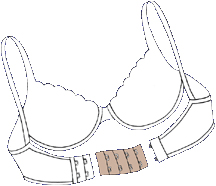
The band can usually be adjusted using the alternative sets of hooks on the fastening. Start on the loosest set when a bra is new, and move inward as the elastic relaxes with wear.
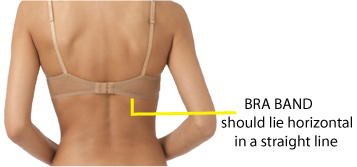

The central panel
The panel between the cups should touch the breastbone and sit firmly against the chest. It is a fast diagnostic because it either makes contact or it does not.
A visible gap usually means the style is not working for you, or that the cup is too small to let the panel reach the chest. Two exceptions are worth knowing: this test does not hold reliably for larger breasts, and minimizer bras frequently do not achieve full contact by design.

The cups
The cup should contain the breast completely, with the edges lying flat against the skin.
Cup too small
Tissue spills over the top, the bottom or the sides. Compression and bulging at the edges are the signature. The fix is a larger cup size, or a full-coverage style. If the cup feels tight, increase the cup size and leave the band alone.
Cup too large
The cup wrinkles and puckers, and you can see ripples or bumps under clothing. There is excess fabric that the breast is not filling. Go down a cup size.
Cups that are too large also cause straps to slip off the shoulders, because the bra has nothing to anchor against. If your straps keep falling, check the cup before blaming the strap.
Visible gap at the cup edge
If the edge stands away from the breast, go down a cup size.

The shoulder straps
Straps should sit smoothly and snugly on the shoulder without doing the heavy work.
What correct looks like
- A finger fits underneath. Same test as the band.
- Flat and even on both shoulders, with no buckling anywhere along their length.
- They stay in place without digging in and without sliding off.
- The rear strap does not pucker or ride up.
- Adjusted so the breasts sit roughly midway between the elbow and the shoulder.
Why digging straps are a band problem
This is the most useful thing to understand about strap fit. If the straps dig into your shoulders, the bra is not providing enough support through the cups and band, so the weight has transferred to the straps instead.
The straps should carry no more than about ten percent of the weight. When they carry more, the result is not merely uncomfortable. It contributes to headaches and to back, shoulder and muscle pain.
The fix is almost never tightening the straps. It is a firmer band, which is what should be carrying the load.
Two related points: anyone with a larger bust should avoid thin or narrow straps, which concentrate pressure into a small area and cause muscle pain. Accessories such as shoulder cushions reduce the pressure straps place on the shoulders, and are covered in our guide to bra accessories.


A quick diagnostic table
| Symptom | Cause | Fix |
|---|---|---|
| Band rides up at the back | Band too loose | Smaller band size |
| Straps dig into shoulders | Band not supporting | Firmer band, not tighter straps |
| Straps slip off | Cup too large, or strap set too wide | Smaller cup, or near-set straps |
| Tissue spills over the cup | Cup too small | Larger cup, or full coverage |
| Cup wrinkles or ripples | Cup too large | Smaller cup |
| Gap at the central panel | Cup too small, or wrong style | Larger cup, or a different style |
| Band cuts into the ribs | Band too tight | Larger band, looser hook, or an extender |
Frequently asked questions
What is the fastest way to check band fit?
Drop both straps off your shoulders. If the bra stays in place, the band is doing its job.
Why do my bra straps keep falling down?
Usually the cups are too large, so there is nothing for the bra to anchor against. Strap placement is the other cause, and near-set straps hold better on sloping shoulders.
My straps dig in. Should I loosen them?
Loosening helps briefly but does not fix the cause. Digging straps mean the band is too loose and the weight has moved to the straps. Get a firmer band.
The band is comfortable but the cup is tight. What now?
Go up a cup size and keep the same band. Increasing the band to relieve the cup loses you the support.
For the measurements behind these sizes, see determining your bra size.