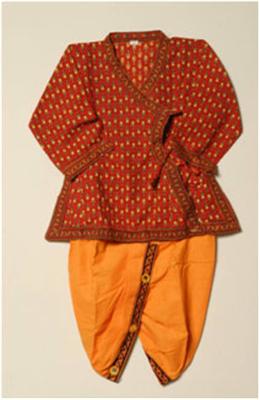
The angarakha is a traditional Rajasthani upper garment for men: a full-skirted tunic with a triangular opening at the chest, closed by wrapping one panel across the other and tying it in place. Behind the opening sits an inner flap called the parda, which covers the chest where the outer panels part.
The construction
What separates an angarakha from a straight tunic is that it does not simply button down the middle. The body is cut so that one side crosses over the other, and the fastening happens along that diagonal.
The garment is fastened at the neck, chest, underarms and waist, using either tie cords or small fabric-covered buttons and loops. Because the closure runs along a diagonal rather than a vertical, several fastening points are needed to hold the wrap flat, and those points become part of the garment’s visible design.
Size, shape and fullness vary considerably. There is no single cut, and the skirt can be anything from moderately full to very full indeed.
Which side ties, and why it matters
The direction of the wrap is not arbitrary, and it carries meaning.
In Muslim traditions the outer tie cords are positioned under the right armpit. In Indian traditions they are positioned under the left. The inner tie cords sit on the opposite side in each case, holding the under-panel in place.
It is a small detail with a large amount of information in it, and it is the first thing to look at when identifying a garment’s origin.
Fabric
The angarakha spans the full formality range, and fabric does the work of placing it.
- Formal occasions. Rich brocades and silks, which hold the fullness of the skirt and give weight to the drape.
- Casual wear. Cotton voile, frequently block-printed. Light, breathable and suited to the climate the garment comes from.
The angarakhi
The angarakhi is the shorter version. It uses the same cuts and the same crossed-panel construction, with the length reaching just below the hips rather than falling into a full skirt.
Beyond length, the details vary as freely as they do in the full-length garment: flare, piping and color are all open, and those choices are what distinguish one angarakhi from another.
How it is worn
The angarakha is worn in combination with dhotis. The draped lower garment balances the fullness above, and the pairing is traditional rather than optional.
The angarakha neckline in modern clothing
The full garment is now largely occasion wear, but its most recognizable feature has had a much wider second life. The angarakha style has been incorporated into necklines across both menswear and womenswear, appearing as an asymmetric crossed opening with a tie at one side.
On a contemporary kurta, blouse or dress, this reads as a design detail rather than a traditional garment, but the construction is directly borrowed and the tie sits exactly where it always did.
Frequently asked questions
What is the parda in an angarakha?
The inner flap that sits behind the triangular chest opening, covering the chest where the outer panels separate.
What is the difference between an angarakha and an angarakhi?
Length. The angarakhi uses the same cut but ends just below the hips, while the angarakha continues into a full skirt.
Is the angarakha only worn by men?
Traditionally yes, as Rajasthani men’s upper wear. The neckline it gave rise to is now used in womenswear as well.
How can you tell a Muslim angarakha from an Indian one?
By the tie side. Outer cords under the right armpit indicate the Muslim tradition; under the left indicates the Indian one.