Some films arrive with stars, massive marketing campaigns and thousands of screens. Hanuman Ansh arrived almost quietly.
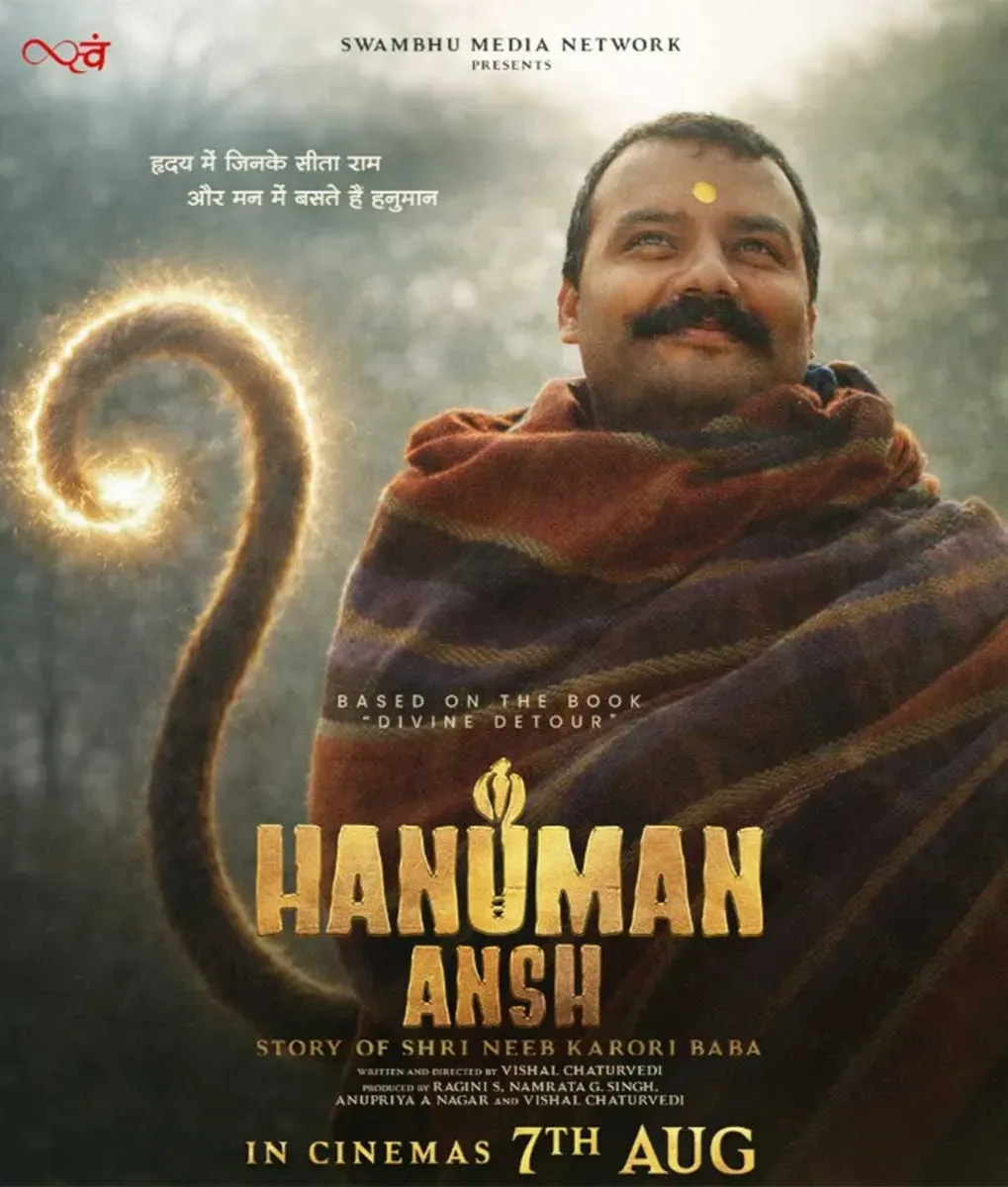
Made on a reported budget of around Rs 1.75 crore to Rs 2 crore, with no major star power behind it, the spiritual drama looked like the kind of film that could easily disappear after a few days in theatres.
Instead, it became one of the most surprising success stories of 2026.
From an opening of roughly Rs 10 lakh to crossing the Rs 100 crore mark in India, Hanuman Ansh is now being talked about as a rare example of what can happen when faith, sincere storytelling and audience support come together.
What Is Hanuman Ansh About?
Directed by Vishal Chaturvedi, Hanuman Ansh is inspired by the life and spiritual influence of Neem Karoli Baba, the revered Indian saint whose followers extend far beyond India.

Neem Karoli Baba is also known for his unusual connection with the global technology world. Steve Jobs travelled to India in the 1970s hoping to meet him, while figures such as Mark Zuckerberg and other Silicon Valley leaders have spoken about the spiritual influence surrounding his legacy.
At the centre of the film is not spectacle but spirituality, devotion and the idea of surrendering to something greater than yourself.
Interestingly, the project itself has an unlikely origin. Reports say 21 year old economics student Anupriya Nagar began researching Steve Jobs for a university assignment. That research eventually led her to Neem Karoli Baba, and what began as an academic project slowly developed into the idea for Hanuman Ansh.
It is difficult to imagine a more fitting beginning for a film whose own journey would later become so unexpected.
A Rs 2 Crore Film Nobody Expected to Become This Big
Hanuman Ansh released theatrically on August 7, 2026, after its original July 31 release was postponed.
The beginning was anything but spectacular.
The film reportedly collected only around Rs 10 lakh on its opening day. Its first week brought in roughly Rs 1.08 crore, while the second week slipped further to around Rs 40 lakh.
For most films, that would have been the end of the story.
But something unusual happened. Instead of disappearing from cinemas, Hanuman Ansh started growing.
Then Word of Mouth Took Over
People who watched the film began talking about it.
Clips, reactions and recommendations started circulating on social media. Audiences encouraged other people to watch it, and the conversation gradually became bigger than the film’s original promotional campaign.
By its third week, collections suddenly jumped. What had earned only about Rs 1.5 crore during its first two weeks reportedly collected around Rs 10.5 crore in its third week alone.
The growth became even more dramatic afterwards.
India Today reported that the film expanded from roughly 355 shows on its opening day to more than 7,000 shows as demand increased.
That may be the real story of Hanuman Ansh. The theatres did not create the audience first. The audience created the theatres.
Social Media Became Its Marketing Campaign
Small films often struggle because marketing is expensive. Hanuman Ansh found another route.
Social media effectively became its publicity machine.
People were not simply sharing trailers. They were sharing their emotional responses, talking about Neem Karoli Baba, discussing the film’s spiritual message and encouraging friends and family to watch it.
Even the phrase “Hanuman Ansh” began trending in online conversations beyond the film itself, becoming associated with qualities such as courage, loyalty, determination and strength. That organic conversation gave the movie something money cannot always buy: trust between viewers.
A recommendation coming from another audience member can sometimes be more powerful than a billboard.
From Rs 10 Lakh Opening to Rs 100 Crore
The box office transformation has been extraordinary.
By its 30th day, reports placed the film’s gross collection at around Rs 117.27 crore, with India net collections close to Rs 99.13 crore.
Another report put the film above Rs 100 crore in India by its fifth Sunday. Whichever box office methodology is used, the scale of the turnaround is remarkable.
A film reportedly made for less than Rs 2 crore has delivered returns that much larger productions can only dream about. And it did so without a superstar carrying the film.
The OTT Rejection That Makes the Story Even Better
There is another chapter that makes the journey even more striking.
Director Vishal Chaturvedi recently revealed that he had earlier approached an OTT platform with the project.
According to Chaturvedi, the pitch was not simply rejected. He felt the manner in which it was dismissed was derogatory.
Rather than abandoning the idea, the rejection strengthened his determination to make the film and take it to theatres.
Today, that rejection almost feels symbolic. A film considered unsuitable by one platform eventually found millions of people willing to embrace it themselves.
Even Getting Theatre Shows Was a Fight
The struggle did not stop once the movie was completed.
Chaturvedi has also spoken about how difficult it was initially to secure enough shows because multiplexes naturally preferred bigger commercial releases.
At one point, he reportedly feared that the movie would fail simply because audiences would not get the opportunity to see it.
Then public demand changed everything.
Shows increased, screenings began filling up and the small spiritual film found itself competing with productions made on vastly larger budgets. That is perhaps why its success feels different from an ordinary hit.
It had to earn almost every screen.
Faith Behind the Camera Too
The makers have also spoken about treating the subject with unusual personal discipline.
Chaturvedi said he followed a fruit based diet for more than four months while working on the project, while vegetarian food was reportedly maintained on the sets to preserve the spiritual atmosphere surrounding the film.
Even the casting carries an unlikely story. Shobhinaw Satyaa, who plays Neem Karoli Baba, was originally working on the film as an assistant director before circumstances led to him stepping into the lead role.
Again and again, the making of Hanuman Ansh seems filled with moments that were never part of a conventional Bollywood plan.
When the Impossible Starts Looking Possible
There is a temptation to call the success of Hanuman Ansh a miracle. Perhaps that is fitting for a spiritual film.
But there is also something very practical behind it. Someone believed in an unusual story. Someone continued after rejection.
A small team made the film with the resources they had. Audiences discovered it. Social media carried the message further.
And theatres eventually followed the audience.
Faith may have inspired Hanuman Ansh, but good work gave that faith something people could respond to.
Its success is a reminder that cinema does not always need to begin with Rs 200 crore, a famous surname and an enormous publicity campaign.
Sometimes it begins with Rs 2 crore, a story you deeply believe in and enough courage to keep going when almost everyone else thinks it will not work. And every once in a while, the audience does the rest.