The rainy season is a genuine problem for feet. Dirt, mud and standing water are inconvenient in themselves, and they also bring a large number of infections with them.
Feet take the worst of it because they are the most exposed part of the body to all three. The good news is that almost all of the risk is preventable, and it comes down to three things: the right footwear, the right socks, and a short daily routine.
Wear the right footwear
Footwear is where most monsoon foot problems begin, and fit is the first thing to get right.
Fit
- Wear shoes that fit and are your size. This sounds obvious and is the single largest factor.
- Avoid tight shoes. They leave no room for air, so the skin cannot breathe, and they cause blisters. Tight shoes are considerably worse when damp, because the trapped perspiration breeds bacteria and fungus. Foul odor is the first sign, and foot disease follows.
- Avoid loose shoes too. They look poor, they are uncomfortable to walk in, and they scoop up a large volume of water the moment you step out in the rain.
Material and construction
- Choose porous surfaces. Shoes and sneakers that breathe allow proper air circulation, which is what keeps perspiration down.
- Flip-flops are well suited to the season. They let the feet breathe and any moisture evaporates almost immediately.
- Choose sandals with minimal padding around the straps. Padded straps hold water, never fully dry, and become a breeding ground for germs.
- Look for good streamlining underneath. A properly patterned sole grips wet ground and stops you slipping. Sandals built this way also handle rough terrain and mud, and they last well.
Rotate your shoes
Keep more than one pair and rotate them daily. Each pair gets time to air out and dry fully between wears, which prevents the damp cycle that causes both odor and infection. It also adds years to the shoes themselves. A shoe tree speeds the drying and holds the shape while a pair rests.
Wear the right socks
The right socks keep shoes dry, clean and germ free, and they are easy to get wrong.
- Avoid tight socks and stockings. They cramp the toes exactly as a poorly fitted shoe does.
- Avoid wrinkled socks, and any that are too large or too small. All three cause blisters.
- Choose natural fibers. Wool and cotton let the skin breathe. Synthetic and nylon socks restrict air circulation, which is the opposite of what wet weather calls for.
- Match the fiber to the season. Woolen socks in winter, cotton in summer.
- Check the elastic. Tight elastic is painful and restricts circulation. Loose elastic slides down and looks awkward. You want a firm but comfortable band.
- Wear clean socks and change them daily. This is non-negotiable in wet weather.
- Wear loose cotton socks to sleep in if you wear any at all overnight.
Anyone who reacts to dyed fabrics should stay with white socks and avoid colored ones.
Nourish your feet daily
The routine is short and it is the part that actually prevents infection.
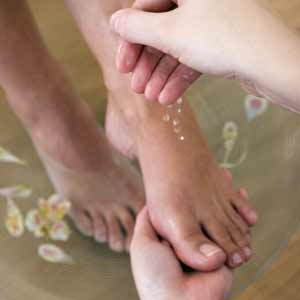
- Wash on returning home. Every time, with soap and water. This removes the dirt and standing water that carry the risk.
- Pat dry. Thoroughly, and particularly between the toes, which is where fungal infection starts.
- Apply powder or moisturizer, whichever your skin needs, and massage it in to encourage blood circulation.
- Air the feet dry whenever they have been wet, rather than putting them straight back into closed shoes.
Toenails
Keep toenails clean and trim them straight across. Do not cut into the corners. A nail cut down at the corner grows back into the skin, and an ingrown toenail is painful for a long time and slow to resolve.
One habit worth keeping
Wipe your shoes inside and out before putting them on. It keeps them clean and germ free, protects your feet from the infections that live in a damp shoe, and quietly adds a few years to the shoes.
Frequently asked questions
What footwear is best in the rain?
Open styles that dry fast. Flip-flops let moisture evaporate immediately, and sandals with a good grip pattern and minimal strap padding handle wet ground without staying damp.
Why do my shoes smell in the rainy season?
Trapped perspiration in a damp shoe breeds bacteria and fungus. Rotating pairs so each dries fully, and choosing breathable materials, fixes it at the source.
Are synthetic socks bad in wet weather?
They are the wrong choice. Synthetic and nylon socks restrict air circulation and hold moisture against the skin. Cotton and wool are better.
How should toenails be cut?
Straight across, never into the corners. Cutting the corners down is what causes ingrown nails.