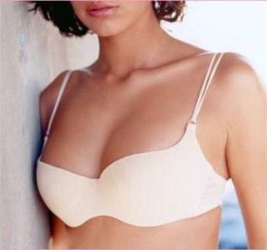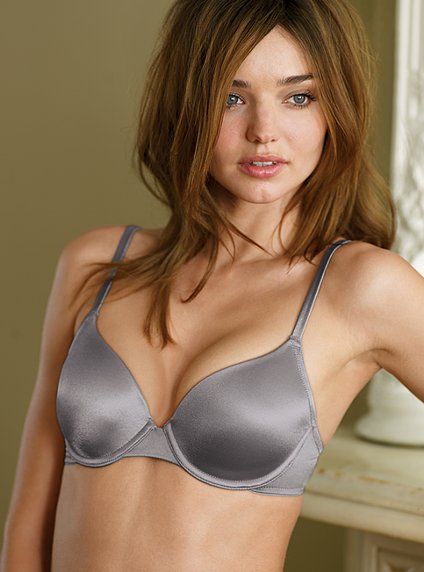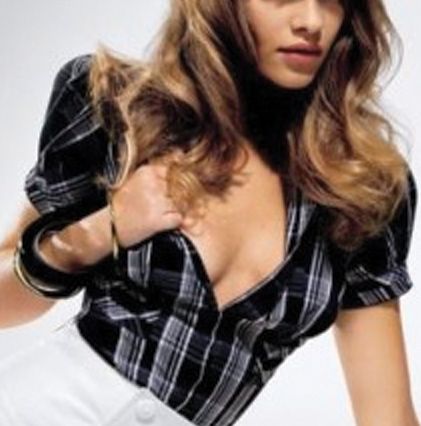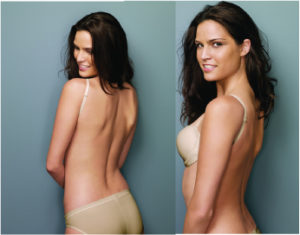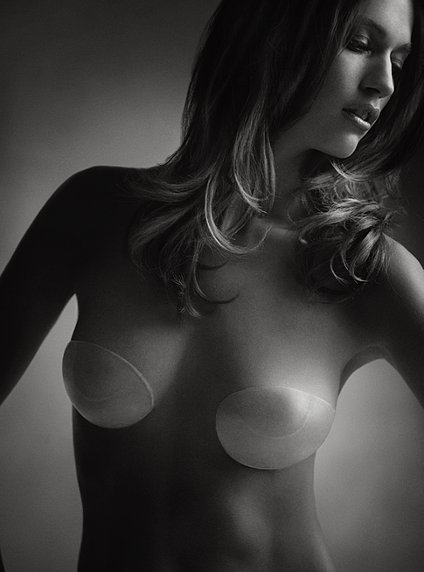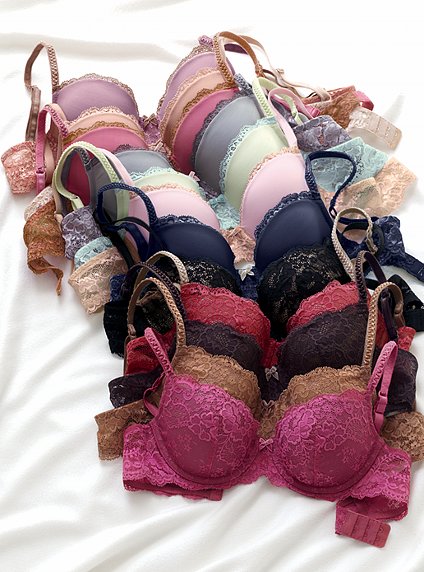
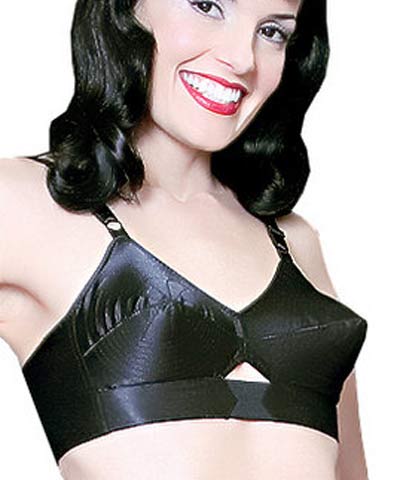
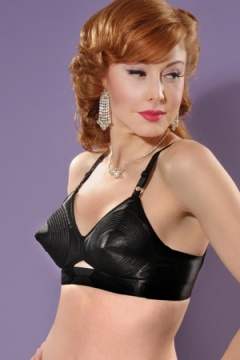
These three bras have almost nothing in common except that each takes a distinctive approach to the cup. One is a historical silhouette, one is designed to reveal, and one is designed to disappear.
Bullet bras
The bullet bra, also called a torpedo or cone bra, was widely popular during the 1940s and took shape through the Cold War era. It is named for its pointed, conical form, and the profile is often compared to the nose of an aircraft.
The construction
A bullet bra is a full-support bra whose cups form a paraboloid of revolution, with the axis projecting outward from the chest. That geometry is what produces the sharply pointed shape, and it is the opposite of modern construction, which follows the natural contour of the body.
The cups were reinforced with circular stitching worked from the center of each cup outward, producing concentric rings centered on the nipple. Some designs used stitched spokes radiating outward in the same manner. The stitching was structural as well as decorative: it is what held the cone rigid.
What it did and did not do
Bullet bras provided full support and coverage, along with considerable lift and décolletage. They also required stuffing. Because the cup held a fixed conical shape whether or not it was filled, many wearers padded them out to fill the form properly.
Decline and revival
By the 1960s and 1970s the conical shape had been entirely displaced by underwires and padding, which shape the breast rather than imposing a form on it.
The silhouette returned once, spectacularly. Madonna wore a cone bra on the Blond Ambition tour in 1990, designed by Jean Paul Gaultier, and made it one of the most recognizable garments of the period.
Peep-hole bras
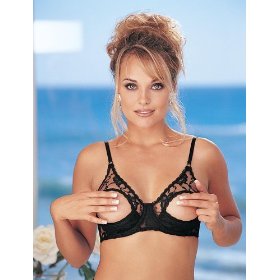
Peep-hole bras are erotic pieces. The cups carry an opening around the nipple, leaving it exposed, while the rest of the cup covers the breast loosely and provides only a little support.
These are display garments rather than functional ones. The construction that creates the opening is the same construction that removes most of the support, so there is no version of this style that also works as an everyday bra.
Natural bras
Natural bras take the opposite approach to the bullet bra. They are built to look and feel like the body rather than to impose a shape on it, which is where the name comes from.
Construction
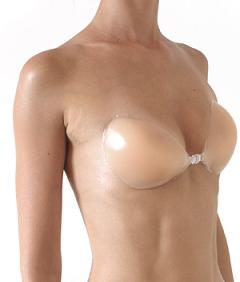
The cups are soft, seamless silicone. Because there are no seams and no rigid structure, they remain invisible even under sheer clothing, which is the main practical argument for them.
They are hypoallergenic and comfortable, and the silicone gives a weight and movement close to natural tissue.
What they do
Natural bras add volume to the bust and produce a smoother silhouette under a dress. Because they need no band or straps to work, they can be worn with strapless, off-shoulder and halter-top clothing where a conventional bra has nowhere to sit.
Frequently asked questions
Why were bullet bras pointed?
The conical cup was the fashionable silhouette of the 1940s and 1950s. The circular stitching held the cone rigid regardless of the wearer’s shape.
Did bullet bras need padding?
Frequently. The cup held its cone shape whether filled or not, so many wearers stuffed them to fill the form.
Are natural bras supportive?
They add volume and shape rather than support. With no band, there is nothing carrying weight, so they suit smaller busts and specific outfits.
Can peep-hole bras be worn under clothing?
They are made as display pieces. The cup opening and the loose coverage make them unsuitable as everyday support.
For the full range see bra categories, and for the history behind the shapes see the evolution of bras.