Broad shoulders are balanced rather than hidden. The working principle is to break up the horizontal line across the top of the body, keep volume off the shoulder itself, and add width lower down so the overall silhouette reads as even.
Necklines
Choose
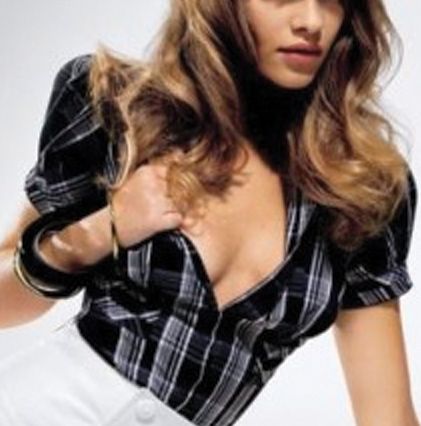
The V-neck is the most useful neckline here, and the most flattering neckline for most women generally. It emphasizes the oval of the face and makes the neck appear longer, producing an overall slimming effect.
The depth is what matters. A V-neck wider than it is long makes narrow shoulders appear broader. A deeper V does the opposite and makes wide shoulders appear narrower, because the long vertical line pulls the eye down the center rather than across the top.
The cowl neckline also works. The extra fabric hanging in scooping folds draws attention toward the chest and neckline, which takes the focus off the shoulders entirely.
Avoid
- Halter. Makes the shoulders look wider than they are.
- Square. Gives the shoulders a broader look by drawing a hard horizontal across them.
- Scoop. Provides maximum chest exposure and puts focus on the chest and shoulders together.
- Boat. The worst offender, and particularly poor with a short neck.
- Off-shoulder. Widens the shoulders directly.
- Turtle. Makes the shoulders read wider than they are.

Waistlines
Start by noticing the triangle formed between your shoulders and your waist. That shape is what you are working with, and it explains why one common instinct backfires: a nipped-in, tightly cinched waist makes the shoulders look bigger by contrast.
Choose
- Dropped waistline. A horizontal line falling three to four inches below the natural waist, near the upper hips. It balances broad shoulders by adding length to the body frame.
- Asymmetrical waistline. Running diagonally across the body with the waist height changing continuously from one side to the other. The diagonal draws attention to itself and makes the body appear taller.
- Natural waistline. Seamed at the natural waist between the ribcage and hips, keeping the garment in proportion and balance.
Avoid
The empire or raised waistline, which enhances the upper body and therefore emphasizes exactly what you are trying to play down.
Sleeves
Choose
- Raglan sleeves. The seam runs diagonally from the underarm to the neckline rather than sitting on top of the shoulder. The smooth unbroken fall removes the horizontal line entirely and makes the shoulder read smaller.
- Sleeveless styles and thin straps. These balance the shoulder without drawing attention to it.
Avoid
- Cap sleeves. They end right at the shoulder, which draws the eye there and makes it more prominent.
- Puff sleeves. The gathering adds visible weight exactly where you do not want it.
Fabrics
Choose light, soft, flowing fabrics that fall from the shoulder rather than standing away from it. Avoid sturdy structured fabrics, which hold their own shape and add apparent width across the top.
Colors
Monochromatic dressing softens the shoulders and makes the whole body read as longer and leaner, because there is no horizontal color break to interrupt the line.
Dark colors on top achieve the same effect, and pairing a dark top with a lighter bottom balances the figure directly.
Prints
Keep prints and detailing small and minimal on the upper body, since any print pulls the eye toward it.
Put the loud prints on the lower half. A boldly printed skirt or pair of trousers moves attention downward and does more for balance than anything you can do above the waist.
Outfits
- A-line skirts and medium-flared trousers, ideally with detail or print. These add dimension to a slimmer lower body and balance the shoulders above.
- Tops with detail at the waist, which highlight the waistline and draw the eye to the middle of the body.
- Dark tops with light bottoms, the simplest version of the balancing principle.
- Empire dresses, which narrow at the top and flare toward the hem.
Avoid
Tops with long, puffed or oversized sleeves, tube tops, and tops with frills or detailing at the neckline. All of them add visual weight across the top of the body.
Accessories
Choose
- Long necklaces, which lengthen and soften the strong horizontal line of the shoulders.
- Small earrings with interesting detail. Avoid heavy, chunky styles, which broaden the whole upper area.
- Bright, colorful clutch or satchel bags, which create a focal point away from the shoulders.
- Stylish, chunky belts, which pull attention to the waist.
Avoid
Opera and matinee necklaces. Both sit around the chest area and emphasize it, which makes the neck and shoulders read broader.
Frequently asked questions
Which neckline narrows the shoulders most?
A deep V-neck. The depth matters: a shallow, wide V does the opposite and broadens them.
Why do raglan sleeves help?
The seam runs diagonally to the neckline rather than sitting on the shoulder, so there is no horizontal line marking the shoulder’s width.
Should I cinch my waist?
Not tightly. A sharply nipped waist makes the shoulders look larger by contrast. A dropped or natural waist balances better.
What is the simplest change to make?
Dark on top, lighter and fuller below. That single move balances the silhouette more than any individual garment choice.
See also body types, the necklines guide and the waistlines guide.