These three share a common quality: each removes some of the structure a conventional bra relies on. That makes them more comfortable and more versatile under difficult clothing, and it means each has a clear limit on the support it can give.
Backless bras
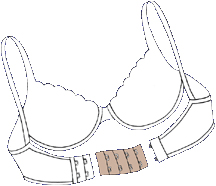
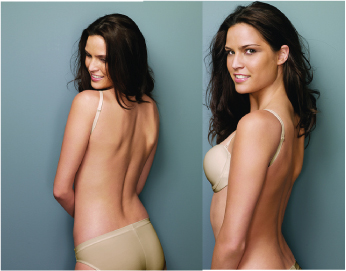
A backless bra is a genuine wardrobe staple, and it earns that description through versatility rather than everyday use.
It exists for a specific situation: a dress that needs ample support without any bra being visible under a backless or deep-cut back. A conventional band cannot solve this, because the band is precisely what would show.
Interchangeable straps
Backless bras with interchangeable straps are considerably more useful than fixed ones, because a single garment then adapts to several necklines rather than one.
Clear straps are the companion feature. They work under strapless and backless dresses generally, including one-shoulder and off-shoulder cuts, where a conventional strap would cross a bare shoulder.
Bandeau
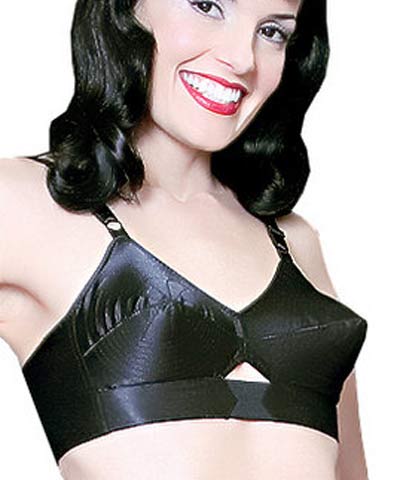
Bandeau is French, and it means to bind centrally. That is an accurate description of the garment: a simple band of cloth worn across the breasts to provide some support.
Variations
- Strapless or halter. Most bandeaus are strapless, but halter-neck versions exist where a little more security is needed.
- Fastening. Some have fasteners at the front, some at the back, and some are elastic enough to need none at all.
- Construction. Bandeaus are made plain, padded or underwired, which spans a considerable range of support from almost none to a genuine structured garment.
How it is worn
The bandeau is unusually flexible about where it belongs. It works under one-shoulder dresses, it functions as swimwear in its own right, and it works as an ordinary bra under clothing. Few lingerie pieces move between those three uses.

Bralette
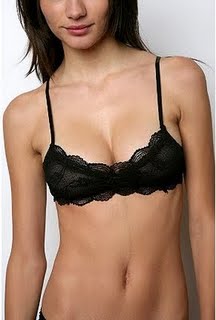
A bralette is an unlined, wireless bra. It is soft, light and unstructured, and it offers correspondingly little support or shaping.
It is best described as a leisure bra. Comfort is the entire proposition, and the minimal support is a consequence of that rather than a design failure.
Who it suits
Bralettes work excellently for A to C cups. Larger busts generally find the style both unflattering and insufficiently supportive, and there is no way around that: the garment has no structure to give.
They also accommodate implants very comfortably, since there is no wire or molded cup imposing a shape.
Choosing between them
| Style | Best for | Support level |
|---|---|---|
| Backless | Low-backed and deep-cut dresses | Moderate to good |
| Bandeau | One-shoulder cuts, swimwear, general wear | Light to moderate |
| Bralette | Comfort, small busts, leisure | Minimal |
Frequently asked questions
What holds a backless bra up?
Construction varies. Many use a low band that sits at the waist rather than across the back, and adhesive versions dispense with a band altogether.
Can a bandeau be worn as swimwear?
Yes. It is one of the few lingerie shapes that transfers directly to swimwear without modification.
Are bralettes supportive?
Minimally. They are unlined and wireless by design, which works well up to about a C cup and not beyond it.
What is the difference between a bandeau and a bralette?
A bandeau is a straight band across the breasts and may be padded or wired. A bralette has shaped cups but no wire or lining.
For the full range see bra categories, and for stick-on options see adhesive bras.