Acetate is a man-made fiber made from cellulose, and it exists for one main reason: it looks expensive. It takes dye brilliantly, it has a natural luster, and it drapes with a fluidity that few other fibers manage at the same price. It is also one of the more delicate fibers in common use, and knowing why explains almost everything about how to look after it.
Where acetate came from
Two Swiss brothers, Dr. Camille and Dr. Henri Dreyfus, developed a commercial process for manufacturing cellulose acetate in 1905. The fiber that followed gave the textile industry something it had not had before: a material with the hand and sheen of silk that could be produced at scale.
What acetate is like to wear
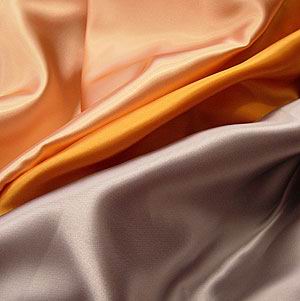
Acetate has a soft, luxurious feel and a distinct luster. It drapes exceptionally well, falling in fluid folds rather than holding a shape, which is why it appears so often in eveningwear and in linings.
Blended with other fibers it lends both of those qualities to the mix, adding beauty and sheen to a fabric that would otherwise be flatter. It is frequently used in satins, taffetas and brocades precisely to accentuate luster and drape.
It also dyes in brilliant colors, holding depth and clarity of shade better than many fibers of comparable cost.
Properties
- Absorbent, but weak when wet. Acetate wets easily and is comfortable to wear because of it, but it loses a significant amount of strength while damp. This single property drives every care instruction that follows.
- Only fair resistance to sunlight. Prolonged exposure degrades the fiber and fades the color, so acetate is a poor choice for anything that lives in a sunny window.
- Chemically sensitive. Strong alkaline solutions and strong oxidizing agents weaken it readily. Harsh detergents and chlorine bleach are both off the list.
- Dimensionally stable. It generally does not shrink, and it can be wet cleaned or dry cleaned.
- Heat sensitive. Acetate softens at relatively low temperatures, which is why a cool iron is not a suggestion.
Where acetate is used
In apparel, acetate appears in linings, dresses and party attire, where drape and sheen matter more than durability. It is a standard lining fiber because it is smooth enough to let a garment slide on easily.
In home furnishings it turns up in draperies, slip covers and upholstery, though its poor light resistance makes it a considered choice rather than an automatic one for curtains.
How to care for acetate
Every rule here follows from the fiber losing strength when wet and softening under heat.
- Never wring it. Wet acetate is at its weakest, and twisting it is how fibers break and fabric distorts permanently.
- Drip dry. Hang it wet and let gravity do the work. No tumble drying, no spinning.
- Use a cool iron. Press on the lowest setting, and ideally on the reverse side through a cloth. Too much heat will glaze the surface or melt it outright.
- Keep it out of direct sun. Both for storage and for drying.
- Avoid bleach and strong detergents. Mild detergent only.
- Check the label first. Many acetate garments are dry clean only for good reason.
Frequently asked questions
Is acetate a natural or synthetic fiber?
Neither exactly. It is a manufactured fiber made from cellulose, a natural raw material, which puts it in the same broad family as rayon rather than with fully synthetic fibers like polyester.
Why does my acetate garment say dry clean only?
Because the fiber weakens when wet and the finish is easily damaged by heat and agitation. Dry cleaning avoids both.
Can acetate be machine washed?
Only where the label allows it, and then on a cold, gentle cycle in a mesh bag. Drip dry afterward and never tumble dry.
Why does acetate crease so easily?
It has poor resilience, meaning it does not spring back after being folded. Hanging garments rather than folding them is the practical answer.