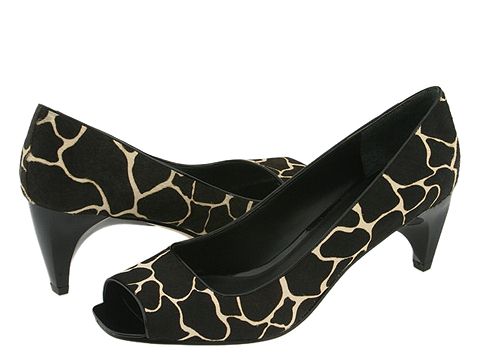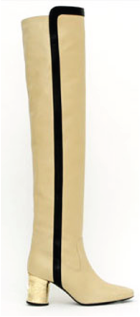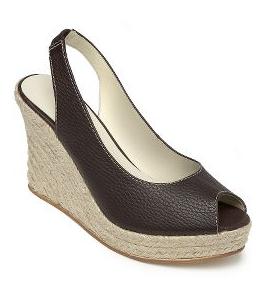
A heel does two jobs at once. It supports the back of the shoe and it sets the visual character of the whole design. These three shapes weight those jobs differently, and the result is three very distinct silhouettes.
Feature heels
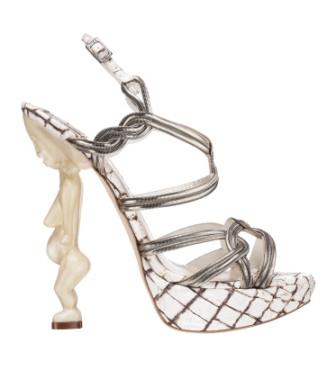
On a feature heel, the heel is the shoe. It still performs its functional role, working as the structural and essential support of the shoe, but it has stopped being a mere tool for creating the illusion of height.
What makes a heel a feature heel
The heel runs high and becomes the main focus and main characteristic of the design. It turns innovative, carrying intriguing and intricate detail. It becomes curvaceous, and frequently it is shaped into a distinguished figure or image rather than a plain column.
This is sculpture applied to a structural component. The design question is how far the shape can depart from a straight support before it stops carrying weight, and the best examples sit right at that limit.
Wearing them
A feature heel is a statement, and it does not share attention. It needs a simple outfit above it, and it needs the heel to be visible, which means it is wasted under a full-length trouser.
Tapered heels
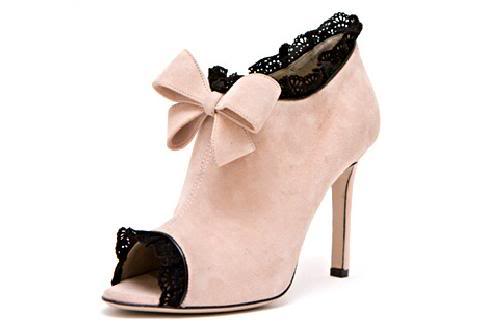
A tapered heel is thicker at the top than at the bottom, narrowing as it descends. It is often curvaceous rather than straight-sided, and the bottom of the heel comes to a point.
How it behaves
The taper is a good compromise. Because the heel is broad where it meets the shoe, it has the strength of a thick heel at the point where the load is greatest. Because it narrows toward the ground, it reads as slim and looks far lighter than a block heel of the same height.
The pointed base is the trade-off. The smaller the contact patch with the ground, the less stable the shoe, and the more likely the tip is to catch in a gap or a grating.

Spool heels
A spool heel is wider at the top and at the bottom and narrower through the middle. The name describes it exactly, since that is the profile of a thread spool.
History
The spool heel was first popular in Europe during the early Georgian era, which makes it one of the older recognizable heel shapes still in use. It reappears regularly, usually when fashion moves toward historical reference.
How it behaves
The spool is the most stable of these three shapes. It is wide where it meets the ground, which gives a large contact patch and good balance, and wide where it meets the shoe, which gives strength. The narrow waist in the middle is what keeps it from looking heavy despite that.
The practical result is a heel you can genuinely walk on that still does not read as clumpy. For anyone who wants height without the instability of a point, this is the shape to look for.

Comparing the three
- Most stable. Spool, by a clear margin, thanks to the wide base.
- Slimmest appearance. Tapered, since the eye reads the narrow bottom.
- Most distinctive. Feature, which is the entire point of it.
- Most comfortable over distance. Spool again, because the contact patch does the work.
For the more familiar shapes see kitten, stiletto and platform heels, and for how heel choice affects an outfit see matching shoes with the right outfit.
Frequently asked questions
Which heel shape is easiest to walk in?
The spool. A wide base gives the largest contact area with the ground, which is what stability depends on.
What is the difference between a tapered heel and a stiletto?
A stiletto is slim along its whole length. A tapered heel starts thick at the top and narrows as it goes down.
Are feature heels practical?
They vary. The heel is still structural, so a well-made one carries weight properly, but the sculptural shapes are usually built for occasions rather than distance.
Why is it called a spool heel?
Because the profile matches a thread spool, wide at both ends and narrow through the middle.