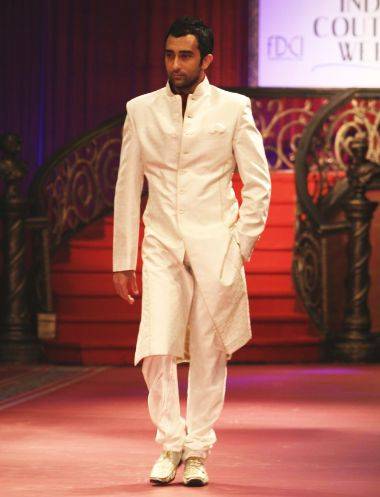
The achkan is a long, coat-like men’s garment with full sleeves, a front button closure running the length of the body, and a high round neck. It sits among the most formal things a man can wear in North India, and it is the standard groom’s outfit across much of the region.
Where the achkan came from
The achkan emerged from the meeting of British tailoring conventions with existing Indian dress. What resulted was a garment with the fitted, structured, buttoned-through construction of a European coat, cut to a length and worn in a way that belonged entirely to Indian formal dress.
That hybrid origin is visible in the garment. It is tailored in a way that older Indian robes are not, and it is long and worn over churidars in a way that no European coat is.
What defines an achkan
- Length. Long, typically falling to somewhere around the knee.
- Closure. A full front button closure running from the collar to the hem.
- Sleeves. Long and full, finished at the wrist.
- Collar. A high, round, standing neckline, most often called the Nehru collar and sometimes the Chinese collar.
- Silhouette. Fitted through the body with a restrained flare below the waist.
Achkan or sherwani
These two garments look alike at a glance and are often sold under either name. The difference is real and comes down to two things: length and flare.
A sherwani is longer than an achkan. A sherwani also carries a wider flare through the skirt of the garment, giving it more volume and movement below the waist. The achkan is the shorter, closer, more restrained of the pair.
In practice this makes the achkan read as slightly less ceremonial, which is why it works for formal occasions generally while the sherwani tends to be reserved for the most elaborate ones.
How it is worn
The achkan is worn with churidars, the tapered trousers gathered into folds at the ankle. That pairing is standard and is part of what defines the look, since the narrow leg balances the length and structure of the coat above it.
Fabric and detailing
Achkans are made in rich, light, fine fabrics, chosen so that the garment holds its shape without becoming heavy over a long occasion.
Decoration concentrates in specific places rather than across the whole garment. The collar, the front edges and the seams are the traditional sites for embroidery, and working those lines is what gives the achkan its richness while keeping the silhouette clean. The button placket itself becomes a design feature for the same reason.
When it is worn
The achkan is the groom’s wedding attire across North India and Pakistan. Beyond weddings it functions as traditional formal wear generally, appropriate for ceremonial occasions, festivals and formal receptions.
Frequently asked questions
Is an achkan the same as a Nehru jacket?
No, though they share the collar. A Nehru jacket is short, ending around the hip. An achkan is a full-length coat.
What is worn underneath an achkan?
Churidars on the bottom, and a kurta beneath the coat. The achkan is an outer layer, not a shirt.
How should an achkan fit?
Close through the chest and waist without pulling at the buttons, with the shoulder seam sitting at the edge of the shoulder. The flare should begin below the waist and hang cleanly.
Can an achkan be worn to a wedding as a guest?
Yes. It is formal enough for the occasion without competing with the groom, particularly in a restrained fabric and with lighter embroidery.