Most sewing problems are matching problems. A needle too heavy for a sheer fabric punches holes in it. A needle too fine for canvas breaks. A woven seam finish on a knit splits the first time the garment stretches.
This chart matches fabric weight to the seam finish, seam type, machine needle size and thread that suit it.
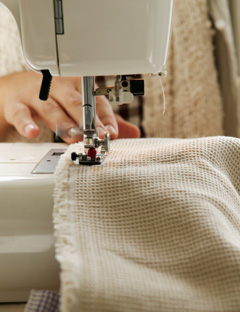
The reference chart
| Weight | Fabrics | Edge finish | Seam | Needle | Thread |
|---|---|---|---|---|---|
| Sheer to lightweight | Gauze, voile, chiffon, organza, crepe de chine, fine lace, tulle, net, georgette | Stitched and pinked, zigzag | French, mock French, self-bound, double-stitched | 9/65 | Extra fine: silk, mercerized cotton, or cotton/polyester |
| Lightweight | Silk, shirtings, gingham, broadcloth, oxford cloth, calico, lightweight linens, chambray, seersucker, tricot, eyelet, challis, organdy, muslin, batiste, dimity, lawn, piqué | Stitched and pinked, zigzag, selvage | French, mock French, self-bound | 11/75 | Extra fine: silk, mercerized cotton; all-purpose cotton/polyester |
| Light to medium weight knits | Cotton knits, tricot, cotton/polyester knits, jersey knits, light sweater knits, stretch terry, stretch velour | Zigzag, straight with overedge | Double-stitched, straight and zigzag, narrow zigzag, straight stretch, elastic stretch | 14/90 ballpoint | All-purpose: cotton/polyester or long-fiber polyester |
| Medium weight | Cotton, wool, wool flannel, rayon, linen and linen types, chintz, wool crepe, gabardine, chino, poplin, denim, corduroy, velvet, velveteen, velour, taffeta, satin, double knits, sweatshirt knits | Stitched and pinked, zigzag, selvage, turned and stitched, bound finishes | Welt, lapped, flat-fell, mock flat-fell | 14/90, ballpoint for knits | All-purpose cotton/polyester, long-fiber polyester or mercerized cotton |
| Medium to suiting weight | Wool, wool blends, tweeds, flannels, gabardine, twill, mohair, boucle, heavy poplin, heavy denim, double knits, quilted fabric | Stitched and pinked, zigzag, selvage, bound finishes | Welt, lapped, flat-fell, mock flat-fell | 14/90, 16/100 | All-purpose cotton/polyester or mercerized cotton |
| Medium to heavy weight | Wool, wool blends, heavy wool flannel, fake fur, fleece, canvas, heavy cotton duck, coating, sailcloth, upholstery fabric | Stitched and pinked, selvage | Welt, lapped, mock flat-fell | 16/100, 18/110 | Heavy duty: cotton or cotton/polyester; topstitching and buttonhole twist |
| No grain, non-woven | Leather, suede, reptile in natural and man-made forms, buckskin, calfskin, plastic, felt | None required | Welt, lapped, mock flat-fell | 14/90, 16/100 wedge point | All-purpose or heavy duty, all types |
How to read the chart
Needle sizes
Needle sizes are given in both European and American numbering, so 14/90 means size 14 American and 90 European. The number rises with the thickness of the needle, and the rule is simply to match it to the fabric: fine fabrics take fine needles.
Two special types appear in the chart and both matter.
- Ballpoint needles for knits. A sharp needle pierces the loops of a knit and cuts them, causing runs. A ballpoint pushes between the loops instead.
- Wedge point needles for leather and non-woven materials. The wedge cuts a slit rather than punching a round hole, which is what allows leather to be sewn without perforating and weakening it.
Edge finishes
The edge finish stops a raw edge fraying. Non-woven materials such as leather and felt need none, because they have no grain and cannot fray, which is why that row is the only one without a finish listed.
Seam types
Enclosed seams such as French, mock French and self-bound suit sheer and light fabrics, because the raw edges are hidden inside the seam where they would otherwise show through.
Flat, strong seams such as welt, lapped and flat-fell suit heavier fabrics, where durability matters more than concealment.
Knits need seams with give: straight stretch, elastic stretch and narrow zigzag all allow the seam to extend with the fabric. A plain straight seam in a knit snaps the first time the garment is stretched, which is the most common failure in home sewing with jersey.
Frequently asked questions
Why do knits need a ballpoint needle?
A sharp needle cuts the loops of a knit and causes runs. A ballpoint pushes between them instead.
What needle size should I use for denim?
14/90 for medium weight denim, moving to 16/100 for heavy denim.
Which seam should I use on chiffon?
A French, mock French or self-bound seam, all of which enclose the raw edges so they do not show through the sheer fabric.
Why does my knit seam keep breaking?
Because a straight stitch has no give. Use a narrow zigzag, straight stretch or elastic stretch seam so the seam can extend with the fabric.
See also natural and synthetic fibers, cotton fabric weaves, wool fabric weaves and silk fabric weaves.