Since 2010 40 countries
Fashion Glossary 3 min read

Applique: The Sewing Technique, Stitches and Uses

Applique is a technique where fabric shapes are stitched onto a ground fabric. Here are the stitches used, how edges are finished, and where it is applied.

On this page

Applique comes from the French for something that has been applied, or put on, and that is a precise description of the technique. Pieces of fabric, embroidery or lace are sewn onto another piece of fabric to build up a design in layers.

Advertisement

It is one of the oldest decorative methods in textiles and one of the most forgiving, because the shapes are cut and positioned before anything is permanently attached.

How applique is worked

The applied pieces have their edges folded inward before being attached. This is the step that separates good applique from bad. A raw cut edge frays with wear and washing, so turning it under encloses the fibers and gives the shape a clean, finished outline.

The folded piece is then stitched down. Three stitches do most of the work.

  • Straight stitch. The simplest option, worked just inside the folded edge. Quick, discreet, and the usual choice when the fabric shape itself is the feature.
  • Satin stitch. Dense parallel stitches worked across the edge, covering it entirely. This produces a solid outline and the most secure finish, and it is what gives machine applique its characteristic raised border.
  • Buttonhole stitch. A looped stitch worked along the edge. It locks the fold down firmly while leaving a decorative ridge, and it is the traditional hand-worked choice.
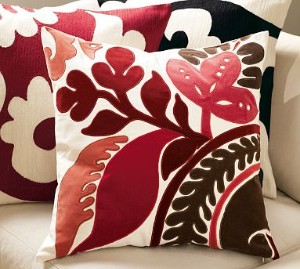
Applique work showing cut fabric shapes stitched onto a contrasting ground fabric
Applique: cut shapes with folded edges, stitched onto a ground fabric to build a design

Pure applique

Pure applique work is the technique in its most direct form: cutting interesting designs and patterns from one fabric and stitching them onto another. No embroidery fills the shapes and no beading is added. The design is made entirely from the cut forms and the contrast between them and the ground.

The discipline of it is in the cutting. With nothing to distract from the outline, the shapes have to be clean and the curves smooth.

Applique and quilting

Quilting is where the technique is used most extensively. Applique suits quilts particularly well because it allows curved and irregular shapes that pieced patchwork cannot easily produce, and because the layered construction of a quilt already accommodates the extra thickness the applied pieces add.

What applique is used on

The technique transfers to almost any fabric surface, which is why it appears so widely.

  • Apparel
  • Bedsheets
  • Pillow covers
  • Lampshades
  • Wall hangings
  • Handbags
  • Folders
  • Envelopes

Practical notes

  • Match the weight of the fabrics. A heavy applied piece on a light ground drags and puckers the base fabric.
  • Prewash everything. If the applied fabric shrinks at a different rate from the ground, the finished piece distorts on its first wash.
  • Clip the curves before folding. Small cuts into the seam allowance let a curved edge turn under smoothly instead of forming points.
  • Baste before stitching. Positioning is everything, and applique is much easier to correct before the permanent stitching goes in.

Frequently asked questions

What does applique mean?

It is French for something applied or put on, which describes the technique exactly: shapes applied to a ground fabric.

Which stitch should I use?

Satin stitch for the most secure and most visible edge, buttonhole stitch for a decorative hand-worked finish, straight stitch when you want the stitching to disappear.

Do the edges have to be folded under?

For a durable finish, yes. Raw-edge applique exists and is used deliberately for a frayed effect, but it will not survive repeated washing the way a folded edge does.

Is applique the same as patchwork?

No. Patchwork joins pieces edge to edge to form a single layer. Applique lays pieces on top of a continuous ground fabric.

Advertisement
← Previous Anklet: Types, Materials and How to Wear One Next → Armlet: The Upper Arm Ornament, Explained

More in Fashion Glossary

All Fashion Glossary →