Appearing taller comes down to one principle applied consistently: keep the vertical line of the body unbroken. Every horizontal break, every contrast at the waist and every pooling hem cuts the body into segments, and a segmented body reads as shorter. Everything below follows from that.
Colors
Monochromatic outfits work better than any other single choice. Building an outfit from varying tones of one color removes the horizontal break where a top meets a bottom, and the eye travels the whole length uninterrupted.
The obvious risk is dullness, and there are two ways around it that do not sacrifice the line.
- Add a third piece. Combine the skirt or trousers with a blazer, cardigan or over-shirt in another color. The long open line of the outer layer is itself vertical, so it adds interest without breaking the column.
- Mix textures. Different fabrics in the same tone give variation the eye can read as detail rather than as a break.

Necklines, prints and patterns
Choose
- V-necks, which add vertical length at the top of the body where a round neckline draws a horizontal.
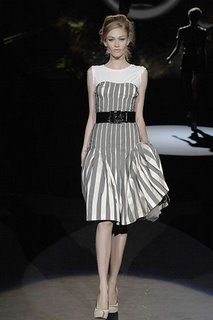
- Vertical stripes, the most direct version of the whole principle.
- Diagonal stripes, which serve the same purpose. A diagonal is closer to vertical than horizontal and carries the eye upward along its length.
- Prints arranged to run vertically, directing downward along the body rather than spreading across it.
Avoid
- Horizontal stripes, which do exactly the wrong thing.
- Mixing colors and prints, which creates breaks and blocks.
- Wide patterns and large floral prints, which spread across the body and do nothing for length.
- Small scattered prints, which read as texture without any direction.
- Big pockets, which add horizontal detail and visual weight.
Clothes
Skirts and hemlines
- Narrower and longer rather than wide and short. Width across the hem shortens.
- Just above the knee is the reliable hemline, leaving the maximum length of leg visible.
- Avoid long skirts, which cover the leg entirely and remove the length you are trying to show.
- Mini dresses work well on a petite frame for the same reason.
Trousers
Boot-cut jeans with a small flare work well. The slight flare balances the shoe and keeps the line of the leg continuing to the floor rather than stopping at the ankle.
Fit
Avoid oversized clothes. On a petite frame, excess fabric adds width without adding height and swamps the proportions. Close-fitting or well-fitting garments are consistently better.
Proportion play
Mixing lengths deliberately works well. A long jacket with a short skirt, or a short jacket with trousers, creates a deliberate proportion rather than cutting the body in half at the middle.
Accessories
- Belts. Avoid wide belts with large buckles, which cut the body horizontally at its center. If you wear a belt, place it just under an empire line or lower down on the hips, where it divides the body unevenly rather than in half.
- Scarves. Tie them loosely so they hang long, and choose vertical stripes or prints running in a vertical direction. Avoid large floral and paisley prints.
- Necklaces. Long ones, such as opera necklaces at 26 to 34 inches, which fall below the bust line. Rope necklaces are good too, and can be doubled or tripled when you want a different look. Pendants work well. Avoid chokers, which draw a horizontal line at the narrowest point of the body.
Footwear
Choose shoes with at least an inch of heel. It does not need to be dramatic, and an inch is enough to change the line. Avoid completely flat shoes.
Two refinements worth knowing. A shoe close to your skin tone extends the leg further than a contrasting one, because the eye reads leg and shoe as a single length. And a low-cut vamp showing more of the foot lengthens more than a shoe cut high across the instep. Ankle straps work against you here, as covered in ankle strap shoes and sandals.
Frequently asked questions
What is the single most effective thing?
Monochromatic dressing. Removing the horizontal break between top and bottom does more than any other change.
Do vertical stripes really work?
Yes, and so do diagonals. Both carry the eye along the length of the body rather than across it.
Should petite women avoid long skirts?
Generally yes. A long skirt covers the leg and removes the visible length. Just above the knee works better.
How high should heels be?
An inch is enough to change the line. Height helps, but an unbroken vertical does more than a tall heel with a segmented outfit.
See also body types and what color to wear.