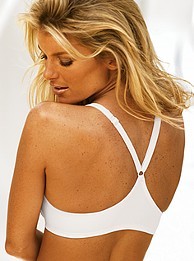
These three bras take three different positions on structure. One adds it, one dispenses with it, and one uses it for the opposite purpose to every other bra in the category.
Underwire bras
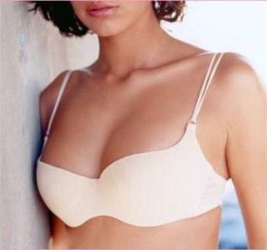
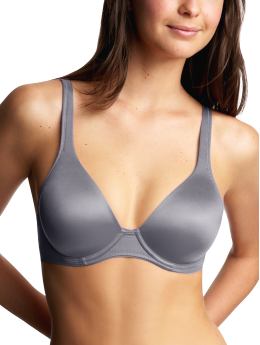
An underwire bra carries a metal or plastic wire running beneath each cup. The wire provides support and shape while allowing the minimum possible coverage, which is why so many low-cut and revealing styles depend on it.
Demi bras, push-up bras, strapless bras and low plunge bras all use underwires, because in each case the cup is cut away and something has to carry the structure.
What correct fit looks like
A properly fitting underwire sits snugly beneath the breast and encircles it, producing a more defined and rounded shape. The wire should follow the natural crease and enclose the whole breast without sitting on any part of it.
If a wire digs, pinches or pokes, the bra is too tight or the wrong shape. That is a fitting fault, not an inevitable feature of underwires.
Who they suit
Underwires work best on straighter frames with less pronounced curves, where the wire has a defined crease to sit in without crossing tissue. Fuller and curvier figures more often find the wire digging in, and hourglass and pear shapes frequently feel it poking into the curve.
There is a second limitation for a larger bust. Because the wire provides a relatively small surface area of support, more of the weight transfers to the shoulder straps, which is uncomfortable. A wider band and fuller cup addresses this better than a wire alone.
One practical tip: a demi cup removes the risk of a wire poking near or under the arms, because the wire ends lower.

Triangle bras
The triangle bra is named for the shape of its cups. It is one of the simplest constructions in the category, and it is made both with underwires and entirely without them.
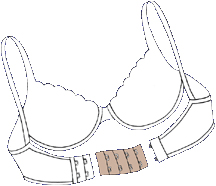
The center of a triangle bra connects directly to the chest band rather than being built into a structured gore, which is what keeps the front so minimal.
Despite the simplicity, a well-made triangle bra provides good support and a natural shape, because the cup follows the breast rather than imposing a form on it.
Male bras
Male bras are worn by men with gynecomastia, a condition in which breast tissue develops.
The design goal is the reverse of every other bra covered here. Rather than lifting or supporting, a male bra is built to conceal and flatten, using compression to reduce the visible profile under clothing.
That difference in purpose changes the whole construction. There is no lift, no shaping toward a fuller line, and no décolletage. What matters is a smooth, flat result and comfort over long wear.
Frequently asked questions
Why does my underwire dig in?
The bra is too tight or the wire is the wrong shape for you. A correctly fitting wire sits in the crease beneath the breast and encircles it without resting on tissue.
Are underwires bad for a large bust?
They provide a small surface area of support, so more weight transfers to the straps. A wide band and a full cup handle a larger bust better.
Do triangle bras need wires?
No. They are made both ways, and the wireless version still gives a natural shape because the cup follows the breast.
What is a male bra for?
Concealing and flattening breast tissue in men with gynecomastia. It compresses rather than lifts.
See the full range in bra categories, and for wireless options see seamless and soft-cup bras.