A boot is footwear that rises from the ankle to the knee or above it. That definition covers an enormous range, and these three sit at very different points on it. One is an everyday winter staple, one is a specialist item with almost no practical mobility, and one is a category defined by perception rather than construction.
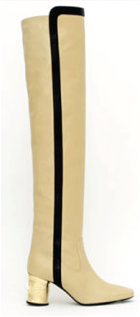
Above-the-knee boots
Above-the-knee boots are made both flat and heeled, though the heeled versions are considerably more popular.
How they are built
The fit is the important part. They are cut tightly around the ankle and up the leg shaft, then left slightly looser at the top. That shaping is what keeps a tall boot from sagging down the leg, and it is why a boot that fits at the calf can still fall down if the ankle is loose.
Most have a zipper closure. With a tight shaft running most of the length of the leg, a zip is the only practical way to get in and out.
What to wear them with
- Short skirts. This is the strongest pairing, and it works with both flat and heeled versions. The gap between hem and boot is the whole effect.
- Jeans. Worn tucked in, so the shaft stays smooth.
- Tights or stockings. Which extend the line of the boot upward rather than interrupting it.
Brown and black are the reliable colors and cover most outfits. Beyond those, matching the boot to the dress is the straightforward approach.
Ballet boots
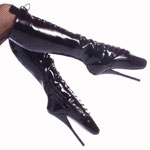
The ballet boot merges the pointed shoe with the high heel. The idea behind it is to hold the foot in the near-vertical position of a ballerina en pointe, using a long, slender heel to do it.
The construction
The heel is typically around seven inches, varying with the size of the shoe. Held upright, the foot is nearly vertical and the entire weight of the body falls on the tips of the toes.
The shaft can rise to any length, though most designs stop at the ankle or the knee. Zipper closures are standard, since the boot could not otherwise be put on.
Mobility
This is the honest limitation. Ballet boots provide severely restricted mobility, and the taller versions stop the leg bending at the knee. They are not walking footwear in any ordinary sense, and they belong to a specialist category rather than a wardrobe.
The same buckled closures used on ballet boots appear on many other shoe designs, including sandals and mules, where they serve an ordinary fastening purpose.
Kinky boots
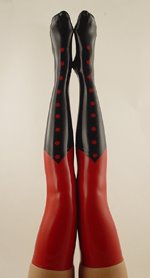
Kinky boots are defined by having some marked and distinguishing characteristic rather than by a single construction. That characteristic is usually one of three things: very high heels, a shaft rising to the thigh or the crotch, or an unusual color or material.
They are generally placed within fetish clothing, associated with shoe fetishism. The category is genuinely ambiguous though, and both the usage and the interpretation shift from person to person. What reads as fetish to one viewer reads to another as high, refined fashion, and the boot itself has not changed.
That ambiguity is worth taking seriously rather than resolving. The thigh-high boot has moved between subculture and mainstream fashion repeatedly, and where any particular pair sits depends on context, styling and the person looking.
Choosing a tall boot
- Check the ankle first. A tall boot falls down from the ankle, not the calf. If it is loose there, nothing higher up will hold it.
- Measure the calf. Shaft circumference varies enormously between makers and is the most common reason a boot does not fit.
- Consider the heel for distance. A flat above-the-knee boot is genuinely walkable. A very high one is not, regardless of how well it fits.
For the shorter styles see footwear for women, and for the heels these boots are built on see kitten, stiletto and platform heels.
Frequently asked questions
Why do my tall boots slide down?
Almost always because the ankle is too loose. The shaft has to be held from below, and a wide ankle lets the whole boot travel.
What is the difference between above-the-knee and thigh-high boots?
They overlap. Above-the-knee describes any shaft ending past the knee; thigh-high describes one that continues well up the thigh.
Can ballet boots be walked in?
Barely. They restrict mobility severely and taller versions prevent the knee bending. They are not general-purpose footwear.
What colors work best for tall boots?
Brown and black cover the most ground. Beyond those, matching the boot to the outfit is the simplest approach.