From the sixteenth century to the early nineteenth, a lock of hair given to a beloved was among the most precious gifts that could be offered. Hair served as a token of love, a mark of admiration and a remembrance of the dead, and the practice was widespread across cultures.
The craft of working hair into jewelry and art forms can be traced back to the sixteenth century, and it reached its height during the Victorian period in the late eighteenth and early nineteenth centuries.
Why hair
Two reasons, and the first is practical. Hair is made of protein that does not decompose quickly, even after death, which made it one of the few parts of a person that could be kept indefinitely.
The second is that there was no alternative. These objects were popular precisely during the period when photography did not yet exist. If you wanted something physical to remember a person by, hair was what there was.
That combination gave hair a specific symbolic weight, standing for both life and death.
What was made
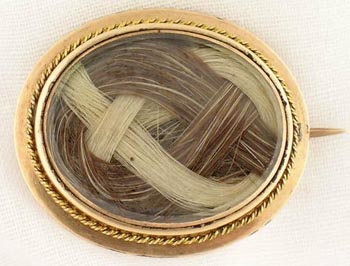
Hair was worked into jewelry, pendants and brooches, and used as a background against which a loved one’s initials were written. Popular items included brooches, bracelets, cuff links, earrings and watch fobs.
Hair bracelets in particular were given as love tokens by men and women alike. It is worth correcting a common assumption here: these pieces were not only mourning objects. They were exchanged between living people as tokens of affection just as often as they commemorated the dead.
The historical record
The practice appears across cultures and periods.
- Egyptian tomb paintings show pharaohs and queens exchanging hair tokens.
- King Christian IV of Denmark gave a hair jewelry item to his queen in the sixteenth century.
- Queen Victoria had jewelry made from her own hair.
- Napoleon wore his watch on a chain made from the hair of his wife Marie Louise.
- Novels of the period refer constantly to the giving of a lock of hair as a token of love and remembrance.
The practice was formalized enough to be documented. Godey’s Lady’s Book and Peterson’s Magazine both carried instructions for exchanging locks of hair between two people and for setting hair into jewelry.
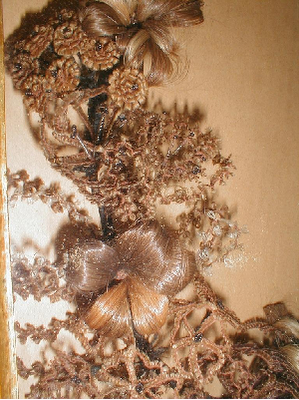
Hair art as a craft
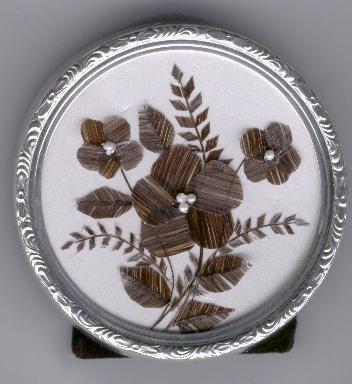
Making jewelry and ornamental items from human hair was a significant art form through the eighteenth century. The hair usually came from a single individual or from members of one family, and beyond jewelry it was worked into landscapes, flowers and wreaths.
Several distinct techniques were used, and they produce very different results.
Hair flower wreaths
Hair is stitched with fine wire over a rod to form loops, and the loops are built up until they take the shape of a flower.
The horseshoe is one of the most common shapes for these wreaths, and they were made at any size. Silk and velvet were used as backing.
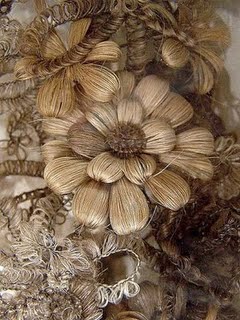
Table work
Weaving or braiding carried out on a special table, using weighted bobbins in the manner of bobbin lace.
The method produces lengths of hair in both solid and hollow tube form, and those lengths are then made up into necklaces, brooches, earrings and bracelets. This is the most technically demanding of the techniques and the one that produced wearable jewelry rather than framed pieces.
Palette work, also called cut work
Folds of hair are layered against one another and glued to a tissue-like backing material that holds them in place. Once dry, the sheet is cut into shapes and patterns.
This is the technique behind most pieces set into pendants and brooches.
Sepia hair painting
The most unusual of the techniques. Finely ground hair is used as the coloring agent in the paint itself, so the color of the painting is literally the color of the hair.
Pastel colors were used only rarely, and some of these paintings incorporate palette work alongside the painted areas.
Frequently asked questions
Was hair jewelry only for mourning?
No. Hair bracelets and similar pieces were exchanged between living people as tokens of love and affection at least as often as they commemorated the dead.
Why was hair used rather than something else?
Hair is protein and does not decompose quickly, so it survives. It was also the only physical keepsake available before photography.
What is table work?
Weaving or braiding hair on a special table using weighted bobbins, producing solid or hollow lengths that are made into jewelry.
What is sepia hair painting?
A painting whose pigment is finely ground hair, so the color of the image comes from the hair itself.
See also our guide to hair accessories.