The A-line is one of the few silhouettes in fashion whose name tells you exactly what it looks like. Narrow at the top, widening in a clean, unbroken line to the hem, the garment traces the shape of a capital A. It is a shape that has stayed in continuous use for seventy years, which is unusual, and the reason is that it does something genuinely useful for a lot of different bodies.
What makes a silhouette A-line
An A-line garment is fitted through the shoulders, bust and upper torso, then flares outward from somewhere between the bust and the hip, falling to a hem noticeably wider than the shoulders. The defining feature is the line itself: it should be straight and clean, widening at a constant rate, rather than gathered, bunched or cinched on its way down.
That last point separates the A-line from shapes it is often confused with. A gathered skirt is full because fabric has been bunched into the waistband. An A-line is full because it has been cut that way, with the width built into the pattern. The result reads as structure rather than volume.
Where the A-line came from
Christian Dior presented the shape in his Spring-Summer 1955 collection and gave it the name. It followed a decade in which Dior had already reset the silhouette once, and the A-line was in part a move away from the tightly nipped waists that had defined that earlier work.
What the A-line offered was structure without constriction. The garment held a strong, recognizable shape, but it did so through cut rather than through corsetry, and it skimmed the body instead of gripping it. That combination is why it survived the collection it was born in. It was picked up through the 1960s, when the shorter A-line shift became one of the defining garments of the decade, and it has never really left.
The A-line family
A-line is a description of a line, not a single pattern, so it covers a wide range of garments.
The A-line dress
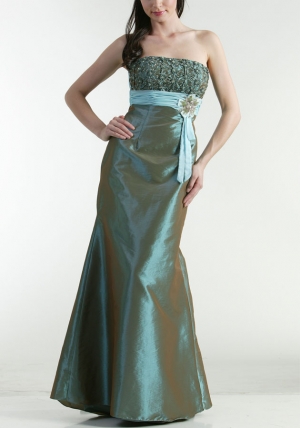
Fitted through the bodice and flaring from the waist or just below the bust. The bodice can be built almost any way you like: halter, strapless, capped, long-sleeved or high-necked. None of that changes whether the dress is A-line, because the classification lives entirely in the skirt.
The A-line skirt
The same principle without the bodice. It sits at the waist or the hip and widens from there. A narrow waistband keeps the line clean at the top, which is the usual construction, though some versions add shaping seams or a small number of flat pleats.
The princess line
A variation built with vertical seams running from the shoulder or armhole all the way to the hem, with no horizontal waist seam at all. The shaping is carried in those long seams. It produces a strong A-line and an unbroken vertical, which is why it reads as particularly elongating.
The A-line coat
Cut narrow at the shoulder and swinging out toward the hem, so it falls cleanly over whatever is worn beneath it. This is the reason A-line coats work over full skirts and heavy knitwear when a straight-cut coat would pull.
Degrees of flare
Not every A-line flares equally. A slim A-line barely widens, and reads as almost straight with a little ease through the hip. A full A-line approaches a quarter circle and moves dramatically. Between the two sits most of what you will actually find in shops, and the degree of flare changes the character of the garment more than any other single variable.
Who the A-line suits
The A-line is unusually forgiving, and it is worth being specific about why rather than repeating the received wisdom that it suits everyone.
- Pear and triangle shapes. This is the silhouette’s strongest case. The skirt skims past the hips and thighs without gripping them, while the fitted bodice keeps the upper body defined. Nothing is hidden, but nothing is clung to either.
- Apple shapes. An A-line that flares from just under the bust moves the widest part of the garment away from the midsection entirely.
- Straight and rectangular shapes. The contrast between a narrow top and a wide hem reads as a waist even where there is little natural definition, which is the cheapest way to create curve without shapewear.
- Hourglass shapes. Works well, but choose a slimmer flare. A very full A-line adds width where there is already width and can flatten the waist definition you already have.
- Petite frames. Also works, with two caveats: keep the hem above or at the knee, and keep the flare moderate. A long, very full A-line can shorten the leg line visually.
Wearing it well
- Watch where the flare begins. The garment’s widest visual point is set by where the flare starts, not by the hem. Higher flares elongate the leg; lower flares emphasize the hip.
- Fit the top properly. The whole silhouette depends on the contrast between a close bodice and an open hem. A loose top collapses the shape into a tent.
- Let the fabric decide the flare. Structured cottons, wools and mid-weight blends hold a crisp A. Soft, fluid fabrics drape rather than stand away, giving a softer and much less defined version of the same cut.
- Keep the hem line clean. Ruffles, tiers and heavy trim at the bottom edge fight the straight line that makes the silhouette work.
- Mind the belt. A narrow belt at the natural waist sharpens the shape. A wide one interrupts the vertical and tends to cut the line in half.
Frequently asked questions
Is an A-line the same as a fit-and-flare?
They overlap but are not identical. Fit-and-flare describes any garment fitted on top and full below, including gathered and circle skirts. A-line is the specific case where the widening happens as a straight, even line built into the cut.
Does an A-line need a defined waist seam?
No. Princess-line garments and A-line shifts have no horizontal waist seam at all and carry the shaping in vertical seams instead. The silhouette is defined by the outline, not the construction.
Is the A-line a formal or casual shape?
Both, and that flexibility is much of its longevity. The same line appears in denim skirts, tailored work dresses, cocktail dresses and bridal gowns. Fabric and hem length carry the formality, not the cut.
What length works best?
Just above, at, or just below the knee is the most reliable range, because it keeps the flare visible while leaving the leg line uninterrupted. Midi and maxi lengths work but need a slimmer flare to avoid overwhelming the frame.