Acrylic nails are an artificial nail enhancement built from two components: a liquid and a powder. Mixed together they form a soft bead that can be shaped over the natural nail, and that then hardens in air into a hard, durable surface. They first appeared in the 1970s, when nobody would have mistaken them for real nails. Modern acrylics look convincingly natural and are considerably stronger.
Acrylics are not press-on nails
The two are often confused and they are different products. A press-on nail is a pre-formed plastic nail that adheres to the natural nail with glue or an adhesive tab, and comes off again. Acrylic is a material that is mixed and sculpted onto the nail, where it cures into a solid layer.
A press-on is finished before it reaches you. An acrylic is built in place. That is why acrylics last for weeks and need filling as the nail grows, while press-ons are a short-term option.
Who they suit
Acrylics are a practical solution for people whose natural nails will not grow to the length they want, and for anyone with brittle nails that split or peel before reaching any length. The acrylic layer takes the wear that the natural nail cannot.
They also create the illusion of long natural nails where the nail bed itself is short, which is a shape problem no amount of growing will solve.
How acrylics are applied
- Prepare the natural nail. Cut, clean and thoroughly dry the nails. Any oil or moisture left on the plate will stop the acrylic bonding, and lifting at the edges is almost always a preparation failure.
- Fit the tip. Select a nail tip that matches the width of your own nail and sits closely against the nail bed. A tip that is too narrow or too wide will never look right no matter how well it is finished.
- Glue the tip down. Apply nail glue and place the tip. Adjust the position before the glue sets, because you will not get a second chance.
- Apply the acrylic. Mix the liquid acrylic and the powder acrylic and apply the resulting bead over the tip and natural nail, blending the join so there is no visible ridge.
- Shape and finish. Once the mixture has hardened, file to shape, buff smooth and apply nail polish.
Decoration
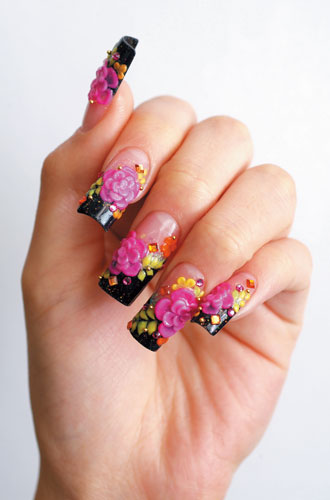
Because acrylic cures into a hard surface, it takes decoration that a natural nail cannot. Designs can be painted directly onto the nail, and acrylics are strong enough to be pierced so that nail rings and charms can be worn.
Looking after them
- Expect to have them filled. As the natural nail grows, a gap appears at the cuticle. Infills every two to three weeks keep the join invisible and the nail balanced.
- Do not use them as tools. Opening cans and scratching at labels is how acrylics lever off, taking a layer of natural nail with them.
- Keep the cuticles oiled. The natural nail underneath still needs conditioning, and dry cuticles encourage lifting.
- Watch for lifting. Any gap between acrylic and nail lets moisture in. Have it repaired promptly rather than leaving it.
- Have them removed properly. Acrylics are dissolved off, not pulled off. Prying them away removes layers of the natural nail with them.
Frequently asked questions
How long do acrylic nails last?
The acrylic itself lasts for weeks. What limits the wear is nail growth, which opens a visible gap at the base and requires an infill.
Do acrylics damage natural nails?
The application itself need not, but improper removal reliably does. Most of the thinning and weakness people blame on acrylics comes from prying them off rather than dissolving them.
What is the difference between acrylic and gel nails?
Acrylic is a liquid and powder that hardens in air. Gel is applied as a thicker medium and cured under a lamp. Acrylic is generally harder; gel is generally more flexible and glossier.
Can I use ordinary nail polish remover?
On the polish, yes. Removing the acrylic itself requires acetone and a proper soak, which is a longer process.