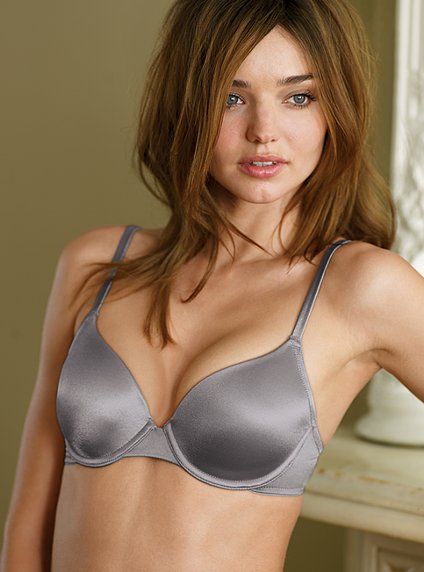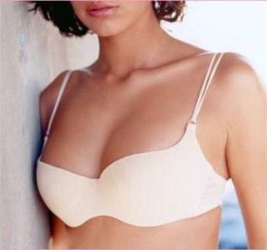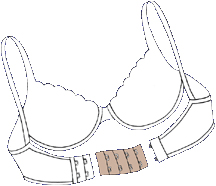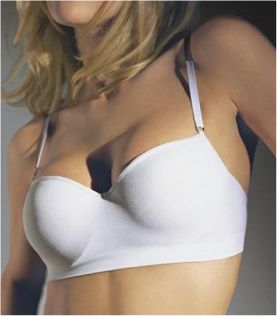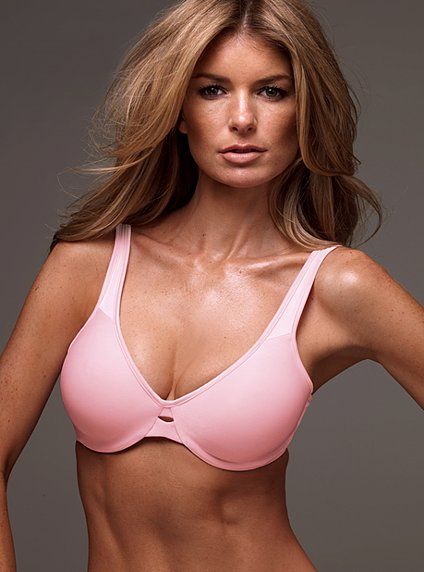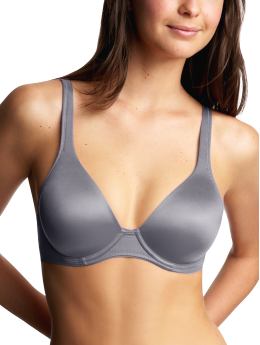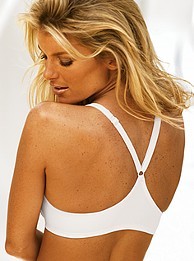
These three bras are all built around practical requirements rather than appearance. One changes where the fastening sits, one maximizes coverage and support, and one solves a specific need after surgery.
Front closure bras
A front closure bra places its fastening, usually hooks and eyes, at the front rather than the back. It opens and closes at a clasp positioned in the center where the two cups meet.
The advantages
- A smooth back. With no hooks across the back, the bra sits flat and invisible under close-fitting clothes.
- Much easier to put on and take off. You can see and reach the fastening, which matters a great deal for anyone with limited shoulder mobility.
- Works with racer-backs. Most racer-back styles use front closures, and the combination is particularly good: the back stays flat and the converging straps are slip-free.
The trade-offs
Two things are worth knowing before choosing one.
Most front closure bras have a single non-adjusting clasp at the center front. That removes all scope for adjusting the band, which is the main way you fine-tune fit in a conventional bra. Finding a well-fitting front closure bra is correspondingly harder.
The center clasp also provides less support than a full central panel does. A conventional gore anchors against the sternum across its whole height; a clasp is a single point.


Full-coverage bras
The full-coverage bra is the practical everyday bra. It provides both full coverage and full support, and it is the benchmark the other styles are measured against.
What it does better
- More coverage and more support than a demi or balconette cup, which is simply a consequence of containing more of the breast.
- No crease or indentation along the top of the breast, because the cup edge sits above rather than cutting across.
- Complete nipple coverage, which eliminates any outline under sheer or body-hugging clothes.
Who it suits
Full-coverage bras are generally preferred over demi styles by women with a larger bust, who need the containment, and by nursing women, who need ample support to keep everything in place.
Many include underwires. Lined cups add both support and opacity, which is worth looking for if show-through is the problem you are solving.


Mastectomy bras
Mastectomy bras are designed for women who have undergone surgery to remove one or both breasts following breast cancer.
How they are built
The cups carry built-in pockets that hold a prosthesis securely in position, restoring the shape and presence of the breast. Some designs use cups filled with fiber instead.
A full-cup mastectomy bra generally gives the most natural result. It holds the prosthesis without shifting, produces a natural silhouette under clothing, and provides comfort to what is often a sensitive area.
Fit matters more here than in any other category, because the bra is holding a weight that does not adjust itself and is sitting against skin that may still be healing. Professional fitting is worth seeking out.

Frequently asked questions
Are front closure bras less supportive?
Somewhat. A single center clasp anchors less firmly than a full central panel, and most offer no band adjustment.
Why choose a full-coverage bra?
For containment and support, and to avoid any cup edge cutting across the breast. It is the most practical everyday choice, particularly for a larger bust.
What holds the prosthesis in a mastectomy bra?
Pockets built into the cups, which keep it in position and stop it shifting during wear.
Which bra works best under a racer-back top?
A racer-back bra, which frequently uses a front closure. The converging straps stay put and the back remains flat.
See also racer-back and strapless bras and the full list in bra categories.